The Desert Became a Screen: Inside Coachella 2026
For two weekends in April, the California desert stopped being a place and became a transmission.
By A.L. Shaw
Editor-in-Chief, ZH Magazine
⸻
For two weekends in April, the California desert stopped being a place and became a transmission.
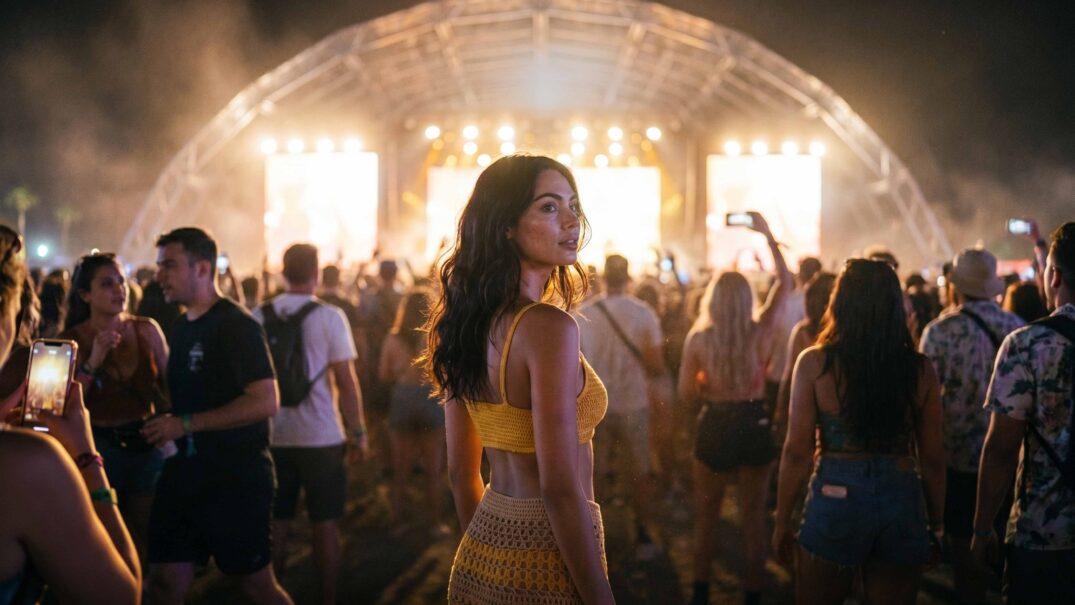
By sunset, the air in Indio carried more than dust and bass. Phone screens floated above the crowd like a second constellation. LED light flickered across sweat, smoke, and designer sunglasses. Somewhere in the distance, a synth line dissolved into helicopter noise and the low mechanical hum of a festival operating at the scale of a temporary city.
Coachella Valley Music and Arts Festival no longer feels like a simple music festival. It feels like a system: part concert, part fashion laboratory, part social media engine, part cultural weather report. The music is still there, of course. So are the heat waves, the impossible logistics, the glowing wristbands, the overpriced water bottles, the exhaustion that settles into the body sometime after midnight. But something else felt louder this year than the speakers themselves: the sense that every moment had already been designed to become an image.
The old Coachella mythology — flower crowns, fringe, bohemian escape, sun-drenched freedom — now feels like a memory from another internet. In its place came something sharper, more cinematic, and strangely more controlled. Outfits looked engineered for cameras before they were designed for movement. Performances unfolded with hyper-choreographed precision. Drops landed like edited film cues. Even the crowd moved differently, aware of itself from above, from behind, from inside the phone screen already waiting to archive it.
This was Coachella as digital ritual.
And nowhere was that transformation more visible than in the relationship between performer and audience. People no longer simply watch festivals. They document them while living them. A scream becomes a clip before the song even ends. A sunset becomes a carousel post before darkness arrives. A chorus becomes a TikTok transition by morning. The moment is experienced and archived simultaneously, which means it is never fully private, never fully present, never fully allowed to disappear.
That may be the real story of Coachella 2026: the disappearance of passive spectatorship.
The biggest performances were not only concerts. They were signals about where culture itself is moving.
Karol G’s headline set represented more than a historic milestone for Latin pop at the festival’s highest level. It revealed how dramatically global music culture has shifted. English no longer operates as the unquestioned center of mainstream pop power. Language now functions more like texture — emotional, rhythmic, aesthetic. The audience did not need translation. The scale of the reaction was the translation.
Elsewhere, Sabrina Carpenter sharing cultural space with Madonna created another kind of collision: not old pop versus new pop, but two entirely different systems of fame briefly occupying the same frame. Madonna emerged from the MTV era, where provocation traveled through television, scandal, and monoculture. Carpenter belongs to a generation fluent in irony, hyper-visibility, algorithmic intimacy, and performance as identity. Their coexistence did not feel like a symbolic passing of the torch. It felt like pop history folding inward on itself.
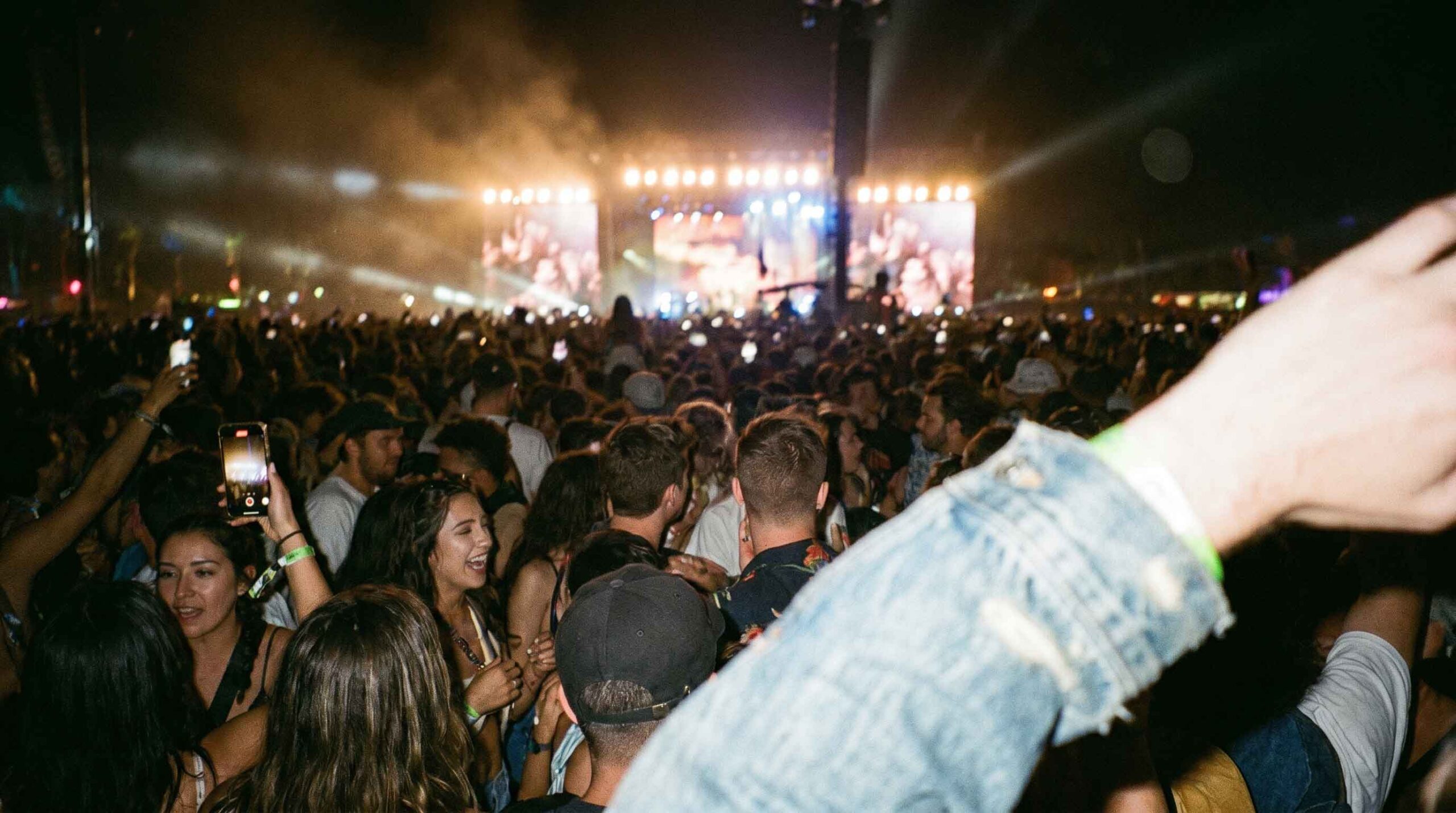
Editorial visual inspired by the atmosphere of Coachella 2026.
Then came Anyma.
At times, his set looked less like a concert than a demonstration of where live entertainment may be heading entirely. Massive digital environments swallowed the stage whole. Human figures appeared trapped inside simulations, floating through hyper-rendered dreamscapes that blurred the line between cinema, gaming engine, installation art, and rave culture. With Lisa appearing within that visual universe, the distinction between performer, avatar, and screen presence became increasingly unstable.
The screen no longer supported the performance.
The screen became the performance.
And yet, beneath all the spectacle, Coachella still revealed something deeply human.
People stood in overwhelming heat for hours chasing moments that lasted seconds. Strangers screamed lyrics together like a collective memory. Couples fought, kissed, disappeared into crowds, reunited near food stands, collapsed onto the grass after midnight, and woke up the next morning to do it all again. Behind the drones, luxury branding, influencer marketing, VIP compounds, and livestream partnerships remained something ancient: the desire to gather around sound, light, bodies, and emotion at a massive scale.
That is why Coachella still matters.
It remains one of the rare places where music, fashion, technology, celebrity, internet culture, and youth identity collide visibly enough to reveal what the culture currently worships. It is excessive, artificial, commercialized, beautiful, exhausting, emotionally manipulative, and occasionally transcendent. Like all large-scale rituals, it exposes the civilization that created it.
By Monday morning, the desert was quiet again. The stages were being dismantled. Dust settled back onto the empty grounds. Wristbands were cut from tired arms. Thousands of videos were already moving across feeds before most people had even made it home.
But Coachella had not ended.
It had simply left the desert and entered the algorithm.