THE EMPIRE OF EUPHORIA
How Coachella 2026 Rewrote the Rules of Cultural Power
By A.L. Shaw
Editor-in-Chief, ZH Magazine
⸻
I. THE OVERTURE: A SYSTEM REVEALING ITSELF
The desert doesn’t forgive. It doesn’t forget. It records.
On the final Sunday of April 2026, as the sun slipped behind the San Jacinto Mountains, a realization moved through the 125,000 people in Indio—not as a reaction, but as recognition.
We were no longer watching a music festival.
We were inside a system revealing itself.
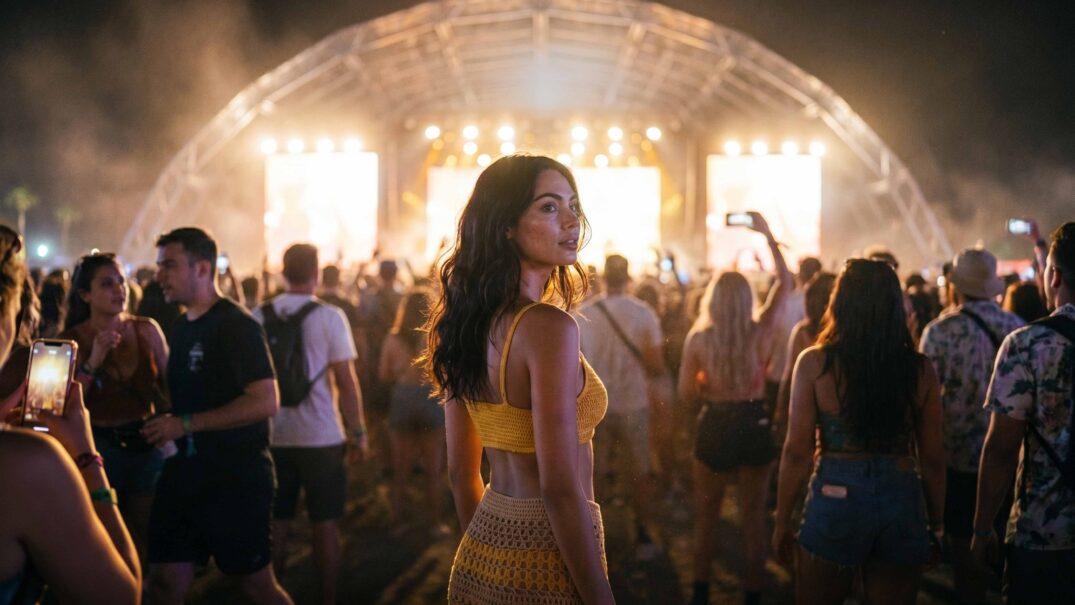
The air carried more than dust. It carried intention. Timing. Precision. Drops landed exactly where they needed to. Screams rose on cue. Phones lifted in near-perfect synchronization—not by direction, but by instinct shaped elsewhere.
This year, the “lineup” was secondary.
What mattered was the system.
II. THE ENERGY OF 2026: DIGITAL BRUTALISM
Coachella 2026 didn’t evolve—it pivoted.
The long era of “boho-chic” nostalgia finally lost its relevance. In its place emerged something colder and more exact: a kind of digital brutalism expressed through bodies, fabrics, and movement.
Clothing was no longer designed for proximity.
It was designed for transmission.
Reflective materials, engineered silhouettes, kinetic details—everything optimized not for the human eye, but for the lens. An outfit didn’t succeed if it looked good in person. It succeeded if it survived the scroll.
Sound followed the same logic.
Electronic music didn’t dominate by popularity alone, but by efficiency—cleaner drops, faster hooks, immediate payoff. Not songs as journeys, but songs as capture points.
Moments engineered to begin—and peak—within seconds.
III. POWER MOMENTS: WHEN THE GRID SHIFTED
Three moments didn’t just define the weekend.
They restructured the map.
• Karol G — The Center Moves
This wasn’t representation. It was a reallocation of power.
Her set didn’t “enter” the global market—it exposed that the market no longer has a fixed center. Language wasn’t a barrier; it was velocity.
• Sabrina Carpenter × Madonna — Inheritance, Not Handover
This wasn’t a passing of the torch. It was a shift in authorship.
Madonna, who once defined the architecture of pop, stood beside an artist fluent in a system where performance, irony, and self-awareness coexist in real time.
• Anyma × Lisa — When the Visual Overtakes the Body
This was the threshold.
The performer no longer needed to be the most compelling element on stage. The visual system—AI-integrated, reactive, immersive—became the dominant presence.
For the first time, the audience wasn’t just watching a performer.
They were inside a rendering.
IV. THE HIDDEN NARRATIVE: THE END OF THE PASSIVE LISTENER
The real story of Coachella 2026 wasn’t on the stages.
It was in the behavior.
The “listener” is gone.
The “viewer” is dissolving.
What remains is something else:
A participant in a loop where experience and documentation are no longer separate acts.
Every gesture—every turn, every pause, every reaction—is subconsciously calibrated for capture. Not staged, but anticipated. Not directed, but conditioned.
This is where the shift becomes irreversible.
The audience is no longer reacting to the moment.
They are shaping how the moment will exist after it ends.
Call it TikTok. Call it algorithmic culture.
At Coachella 2026, it felt closer to a ritual—
a repetition where the present is exchanged for its digital echo.
V. THE INDUSTRY SIGNAL: FROM PERFORMANCE TO SYSTEM
Coachella has always hinted at the future.
This year, it confirmed it.
1. The Artist as Architect
The standalone “pop star” is fading. The dominant figures now are world-builders—designing environments, not just songs.
2. Visual Supremacy Is Absolute
If it cannot translate into a compelling visual frame, it doesn’t scale. Performance is now a subset of cinematic language.
3. The End of Cultural Geography
Language, region, origin—no longer barriers, but textures. Influence moves through velocity, not location.
4. The Audience as Infrastructure
Fans are no longer consumers. They are distributed. Amplification is no longer a strategy—it is behavior.
VI. THE SILENCE AFTER THE STATIC
By morning, the desert was quiet again.
No sound. No lights. No signal.
But the system didn’t end.
It fragmented—into millions of clips, edits, angles, and versions.
A festival that no longer exists as a place, but as a distributed memory—continuously reshaped, constantly alive.
One image remained: thousands of glowing screens capturing a sunset that many never fully looked at.
Coachella 2026 wasn’t about escaping reality.
It was about redesigning it.
And somewhere in that process, something subtle disappeared—
Not the music.
Not the crowd.
Something quieter.
The part of the experience that was never meant to be seen twice.