Adnan Mosallaei: Painting What Survives Time
An editorial essay examining the symbolic realism of Iranian visual artist Adnan Mosallaei through two paintings that explore memory, history, identity, and what endures across time.
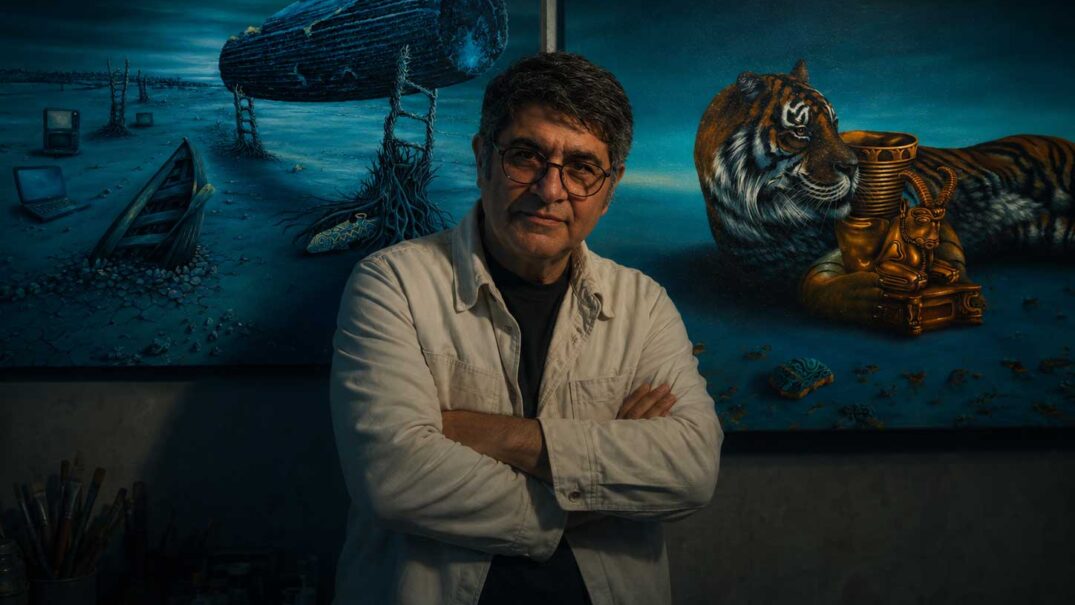
Some artists record the world as it appears before them. Others dismantle it, rearrange its fragments, and rebuild it through memory.
Iranian visual artist Adnan Mosallaei belongs to the latter tradition.
Across a practice spanning painting, watercolor, graphic design, curation, and exhibition-making, Mosallaei has developed a visual language in which history is not treated as a sealed archive. It remains active beneath the present, carried through animals, objects, ruins, landscapes, and symbols that appear to have outlived their original contexts.
His paintings rarely unfold as conventional narratives. Instead, they operate as suspended environments where archaeological forms, abandoned technologies, natural life, and cultural memory occupy the same psychological space.
Reality and imagination are not presented as opposites.
They coexist.
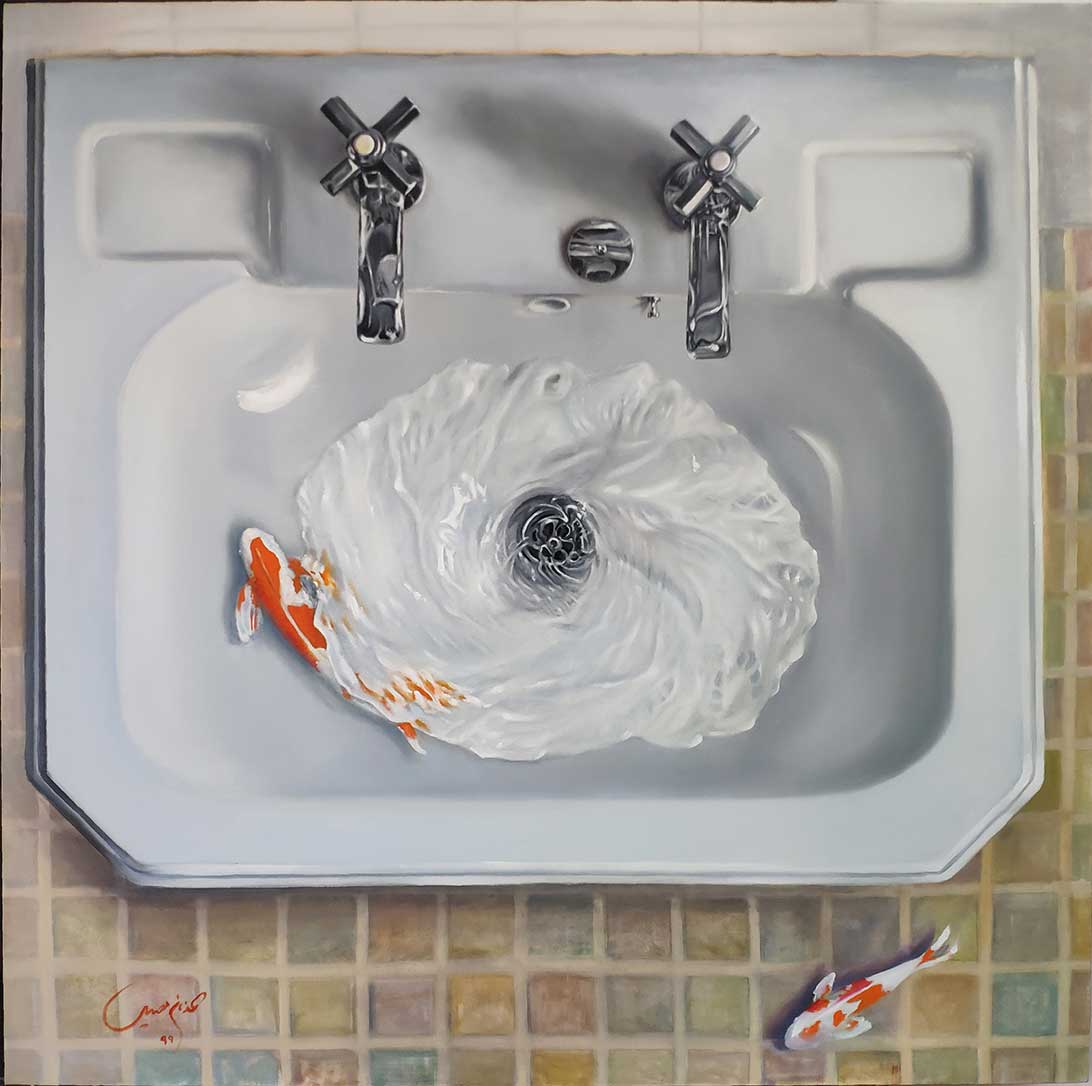
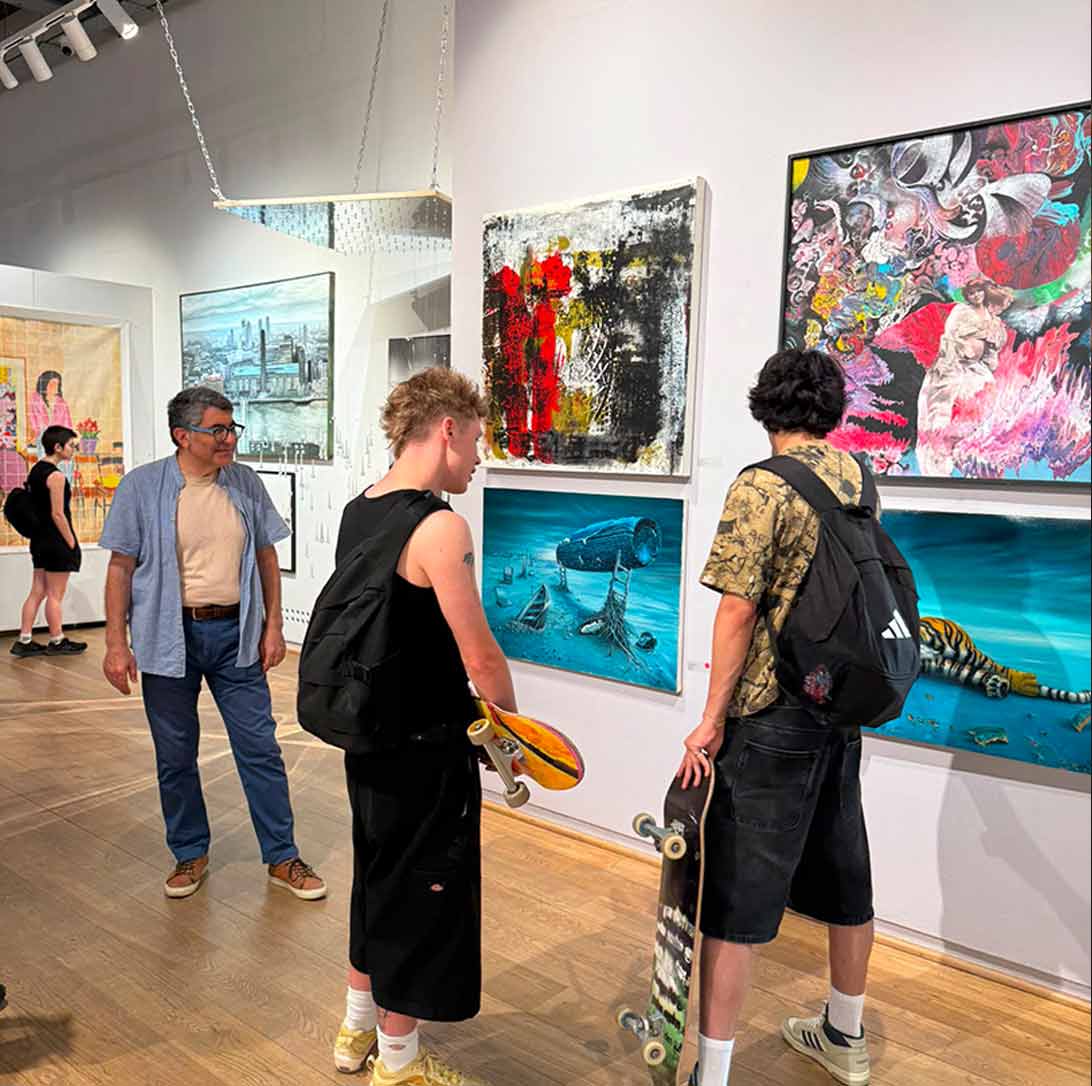
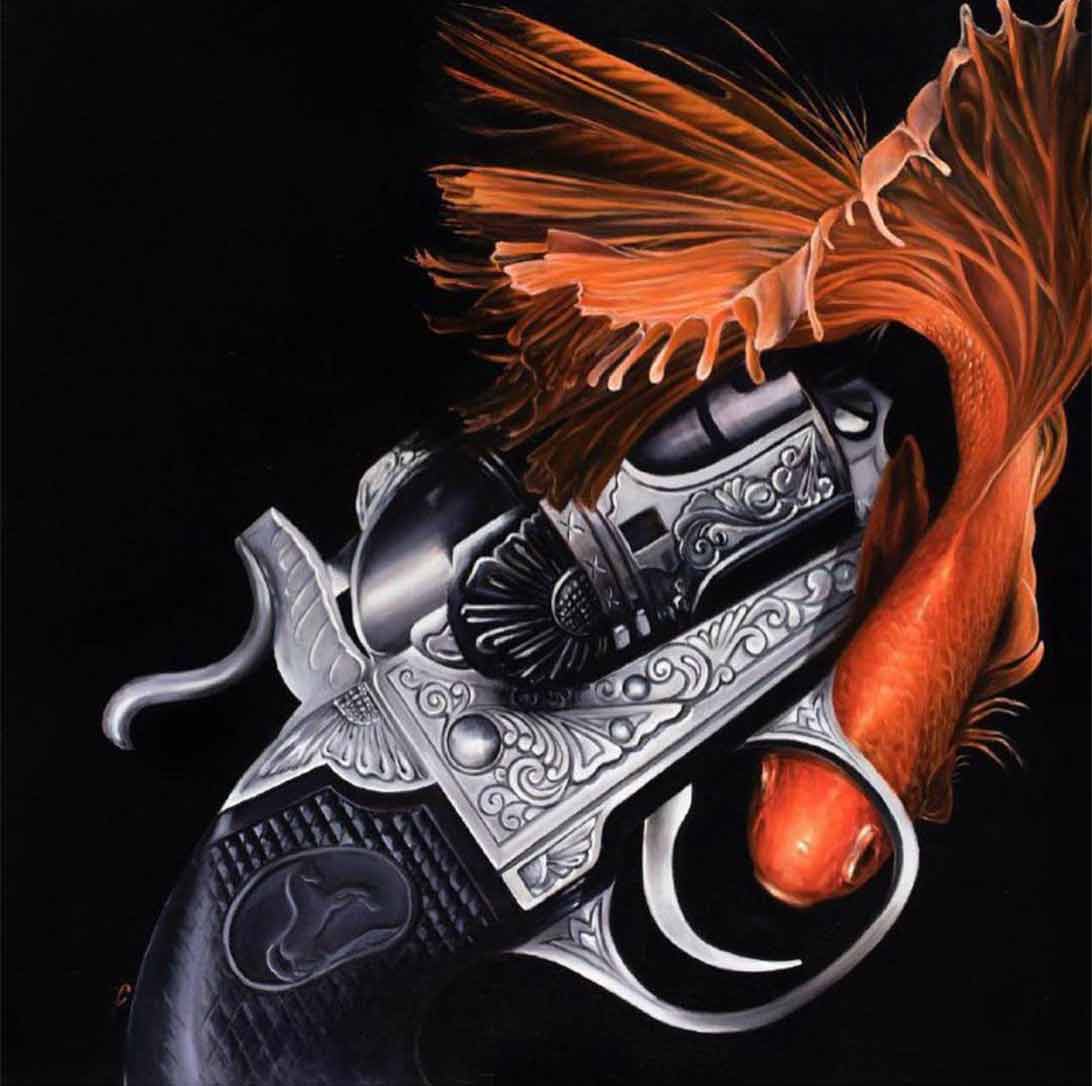
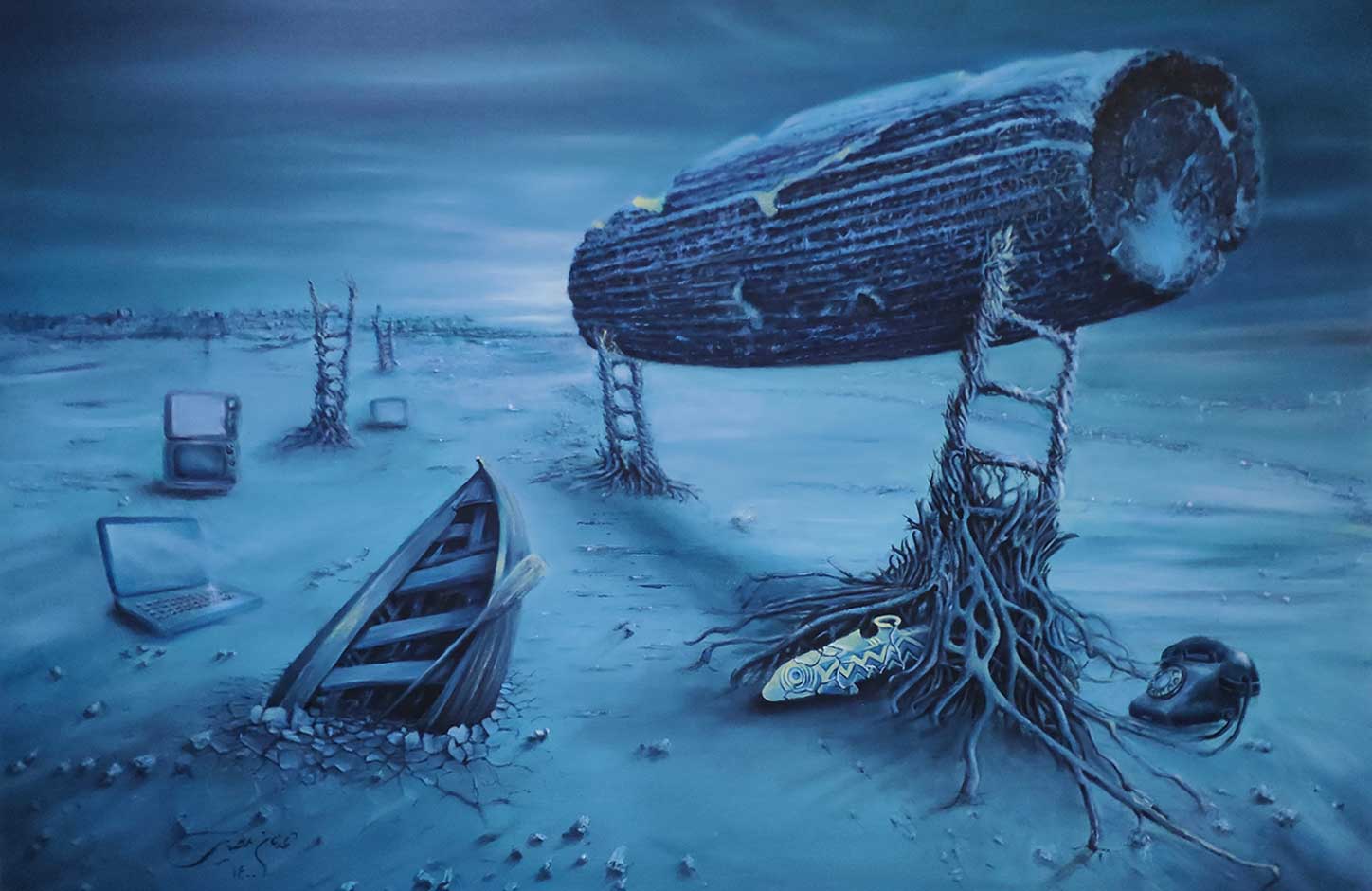
A tiger rests beside golden objects that evoke the visual language of ancient Persian artifacts. A monumental tree rises above exposed roots. A boat remains stranded in an emptied landscape. Screens and communication devices appear silent, stripped of the promise of connection they once represented.
Every element seems deliberately placed, yet the works resist a single interpretation.
Mosallaei does not explain the image to the viewer. He constructs the conditions in which meaning may emerge.
This approach is particularly visible in two paintings shown during the 6th “Rooted in Soil” Biennial at London’s Mall Galleries. Together, they reveal an artist concerned not only with heritage, but with a more difficult question:
What remains after power, technology, and certainty begin to disappear?
The Silent Sovereign
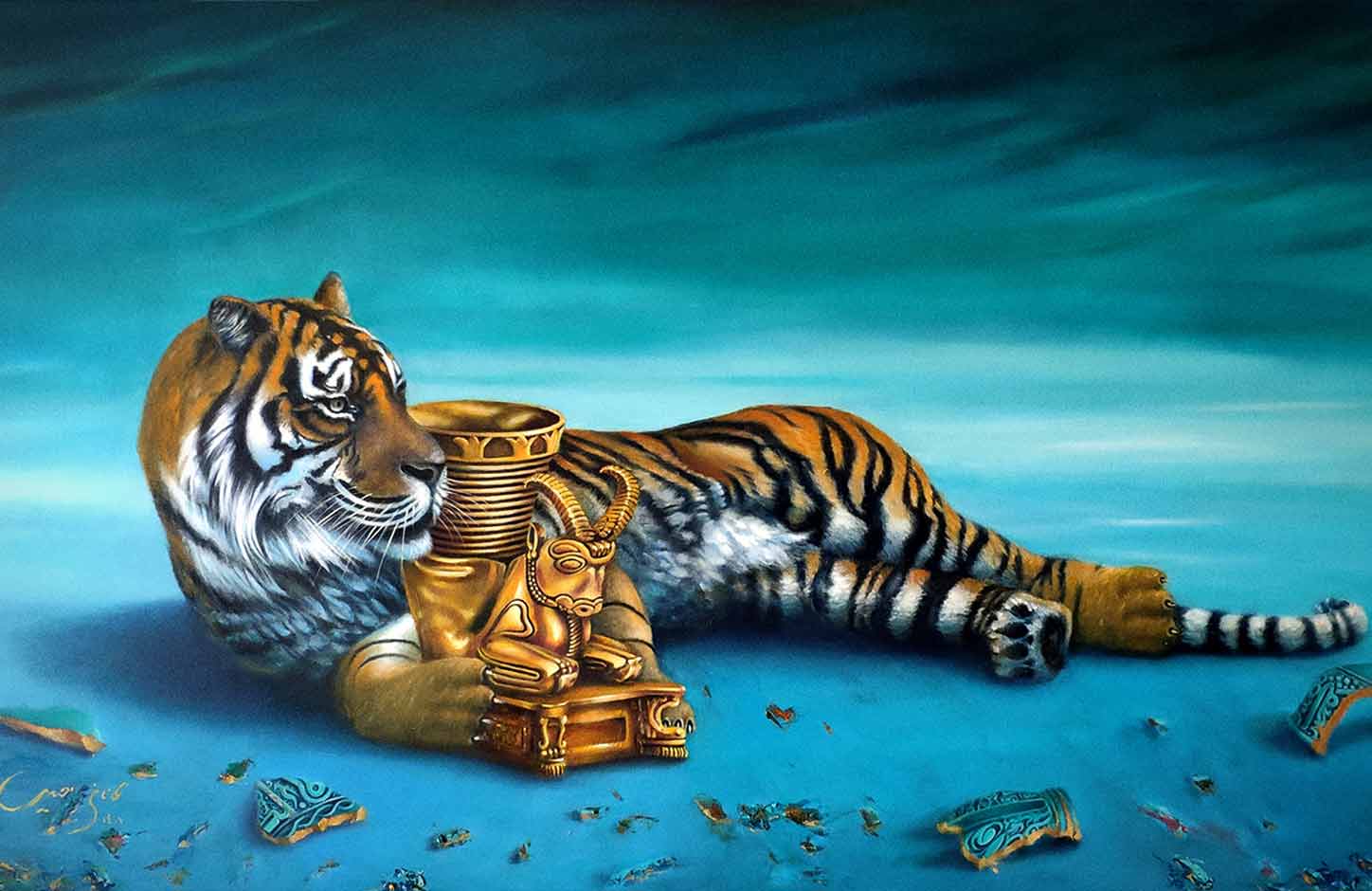
At first glance, the reclining tiger appears calm, almost introspective.
It does not attack or perform the familiar symbolism of dominance. Instead, it occupies the composition through stillness, resting beside a group of golden objects whose forms recall ancient Persian material culture.
The encounter shifts the painting beyond wildlife portraiture or historical illustration.
Here, the tiger becomes something closer to a guardian or silent witness. Its living body exists beside objects that suggest the material remains of a civilization whose political authority has vanished, but whose visual language continues to circulate through cultural memory.
Mosallaei’s treatment of power is particularly significant.
Strength is not expressed through conquest or movement.
It is expressed through endurance.
The tiger appears fully capable of violence, yet remains still. The objects beside it are inanimate, yet culturally charged. One is alive but silent; the others are lifeless but heavy with association.
Between them, the painting creates a dialogue between nature and civilization, instinct and memory, presence and survival.
The saturated turquoise field surrounding the figures removes the scene from recognizable geography. There is no precise landscape, no stable horizon, and no historical setting to explain where or when this encounter occurs.
The image exists outside ordinary time.
Its blue-green atmosphere feels at once aquatic, celestial, and archaeological. Against it, the tiger’s striped body and the concentrated warmth of the gold-toned forms become almost hyperreal—not because they reproduce reality exactly, but because they appear more vivid than the world around them.
Fragments scattered across the ground introduce a quieter disturbance. They suggest breakage, excavation, or the aftermath of an event the painting never reveals.
Nothing offers a definitive conclusion.
Instead, the work raises the possibility that cultural symbols may outlive the political systems that first gave them meaning.
Roots
If The Silent Sovereign reflects on endurance, Roots turns toward continuity, exposure, and displacement.
A monumental tree-like form rises above an almost deserted terrain. Its roots remain visible rather than buried, extending into the landscape as both foundation and wound.
Roots traditionally signify origin, stability, and belonging. In Mosallaei’s composition, however, they also imply vulnerability. What normally remains protected beneath the earth has been brought into view.
The structure survives, but its means of survival are exposed.
Around it, fragments of contemporary life appear abandoned: electronic screens, communication devices, a small boat, traces of architecture, and objects disconnected from any functioning society.
These elements do not form a literal account of migration, technological failure, ecological loss, or historical trauma. Mosallaei keeps their relationships open.
The boat may suggest departure, exile, return, or an interrupted journey. The inactive devices may evoke the limits of technological connection. The exposed roots may recall ancestry, memory, belonging, or the difficulty of maintaining cultural continuity across changing landscapes.
Yet the painting does not reduce these possibilities to a single autobiographical narrative.
Within a contemporary world shaped by movement across borders, the image of exposed roots inevitably opens questions of displacement and belonging. But the work remains deliberately unresolved, allowing viewers to approach it through their own histories and experiences.
The objects appear less like clues in a puzzle than remnants left behind after the narrative has already taken place.
The viewer arrives too late to witness the event and must instead confront its traces.
The painting’s cold chromatic atmosphere reinforces this temporal suspension. The landscape does not appear entirely dead, but it is emptied of ordinary human rhythm. Nature persists while the instruments of modern life have fallen silent.
The contrast is not a simplistic rejection of technology. It raises a more unsettling question:
What happens when systems designed to connect us remain physically present but lose their human purpose?
At the center of the work, the rooted form continues to stand.
Its survival is neither triumphant nor sentimental.
It is simply persistent.
A Visual Language of Memory
Viewed together, the two paintings reveal a broader vocabulary that extends across Mosallaei’s practice.
Rather than building a recognizable artistic identity through repeated imagery alone, Mosallaei constructs coherence through recurring questions. His paintings return, again and again, to the fragile relationship between history, memory, nature, and the human desire to preserve meaning across time.
Animals, historical references, natural forms, urban fragments, and symbols of modernity recur throughout his work. They are connected not only by imagery but by an ongoing inquiry into time, transformation, memory, and the unstable relationship between human civilization and the natural world.
His background in graphic design remains visible in the organization of his compositions. Objects are positioned with clarity, symbolic relationships are carefully controlled, and negative space often carries as much psychological weight as the figures themselves.
His long engagement with watercolor may also help explain the atmospheric transitions and emotional use of color visible in his oil paintings.
Technical precision, however, is not treated as an end in itself.
Realist rendering gives symbolic ideas physical credibility. A tiger, vessel, tree, boat, or computer screen must first feel materially convincing before it can enter the realm of metaphor.
This tension between observation and imagination is central to Mosallaei’s work.
He uses recognizable forms but refuses to keep them within recognizable worlds.
The result occupies a space between symbolic realism and surrealism—a visual territory in which objects retain their physical identity while becoming psychologically unstable.
Beyond Nostalgia
Mosallaei’s engagement with Iranian history does not depend on uncomplicated nostalgia.
The past is not presented merely as a lost golden age, and heritage does not function as decorative identity. Historical references enter his paintings as active visual presences whose meanings continue to change as they move across generations and geographies.
Artifacts acquire new associations beside living animals. Ancient visual forms enter dreamlike contemporary landscapes. Technology appears archaeological before our eyes. Nature is represented as both vulnerable and enduring.
The paintings ask what societies preserve, what they abandon, and what survives through reinterpretation.
They also complicate the idea of progress.
A civilization may produce monuments, technologies, and systems of communication, but time does not guarantee that any of them will retain their intended purpose. What persists may be something quieter: an image, a root, an animal, a story, or a symbol reconstructed by those who inherit it.
What Remains
Born in 1969, Mosallaei studied Graphic Design at the University of Art in Iran before continuing his education in advertising, marketing, and management. His practice has since expanded across watercolor and oil painting, graphic design, publishing, education, curatorial work, and exhibition organization.
He has participated in solo and group exhibitions across Iran, Europe, and Asia, while also working as a curator, workshop leader, exhibition director, author, illustrator, and art consultant.
Yet the breadth of that résumé is not what ultimately defines the work.
What distinguishes Mosallaei is his persistent return to the same fundamental questions.
How do symbols continue after the cultures that produced them have changed?
Can technology preserve human connection, or does it eventually become another abandoned object?
What remains alive when history has reduced everything else to fragments?
His paintings do not answer these questions directly.
They create spaces in which the questions can continue to exist.
That may be why the works reward prolonged observation. Their realism offers immediate access, but their symbolic relationships resist quick resolution. Meaning shifts according to distance, memory, and the experience each viewer brings to the image.
Like the roots exposed in his landscape, the deeper structure of Mosallaei’s work does not remain hidden.
But visibility does not make it simple.
Like memory itself, the paintings reveal more each time we return.
About the Artist
Adnan Mosallaei is an Iranian visual artist, painter, graphic designer, and curator based in London. Trained in graphic design and working across watercolor and oil painting, his practice brings together symbolic realism, surreal imagery, cultural memory, historical symbolism, and contemporary questions of identity, technology, and belonging.
His work has been presented in solo and group exhibitions across Iran, Europe, and Asia, including the 6th “Rooted in Soil” Biennial at London’s Mall Galleries. Alongside his studio practice, he has worked as a curator, exhibition organizer, educator, author, illustrator, and art consultant.
By Ali Shahrokhi